
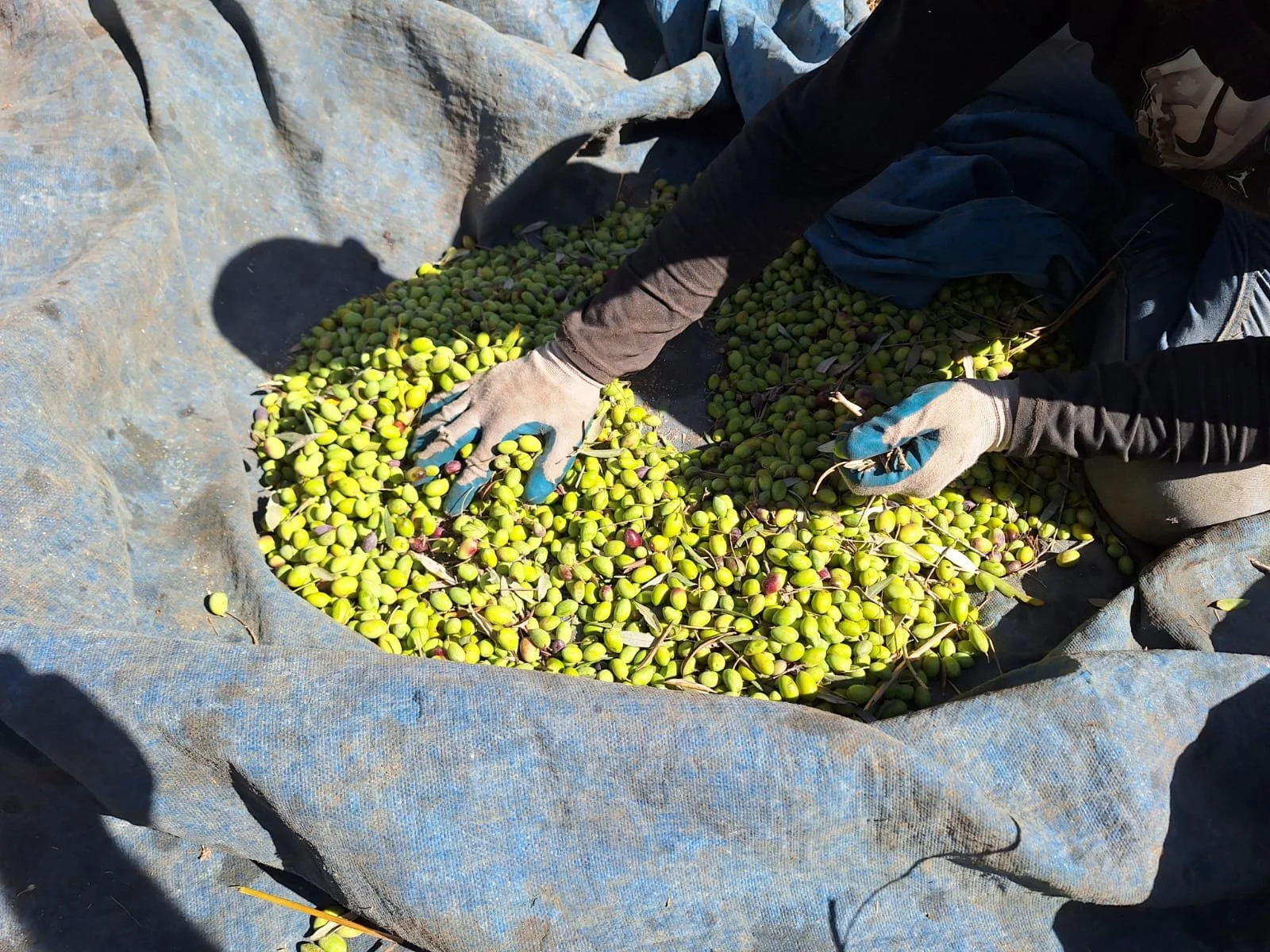
The Olive Harvest
Applications are now closed for the 2026 Olive Harvest.
To make sure you’re getting updates about our work and receiving opportunities to join us on the ground, sign up for our newsletter and follow us on Instagram.
“When internationals come and work with the farmers, it gives us hope and reminds us that we are not alone — that there are real people who believe in freedom and who are in solidarity with us.”
— Ghassan Najjar, Burin Land & Farming Cooperative
More Information
-
The olive harvest is a significant time of the year in Palestinian society, as it is vital to Palestinian agricultural economy and cultural heritage. Tens of thousands of Palestinian families depend on the olive harvest as their primary source of income.
During the harvest season, participants will accompany Palestinians farmers and families on their lands to help in the harvest, act as a solidarity presence, and document when necessary. Participants will also communicate their own experiences to international audiences and work with Palestinians to amplify their stories and experiences living and resisting under occupation and apartheid. Participants will build relationships that will expand and strengthen the coresistance movement and CJNV’s community of Jews taking action in solidarity with Palestinians across the world.
CJNV will provide participants with communal lodging, food, logistical support, orientation and training, group facilitation, and support in “taking the work home.”
-
We are looking for people who can commit to joining us on the ground for two weeks, from October 9 until October 24. People may be able to stay longer on their own (outside the official CJNV dates) if they would like.
We strongly encourage people to apply who have skills and experience in some of the following:
Farming
Civil Disobedience and Direct Action
Nonviolent Theory and Practice
Cross-Community Organizing
Human Rights Accompaniment and Documentation work
Communications and Media
Facilitation or Mediation
Arabic Proficiency
Experience in the region
Participants should also understand that the situation in the West Bank is dangerous and unpredictable. Encounters with settlers, soldiers, and police are likely, and risks can include harassment, physical attack, detention, arrest, deportation, and bans on reentry.
Our Palestinian partners and the farmers we accompany will make the final decisions each day about where and when harvesting takes place based on community needs and the situation on the ground, and participants must be prepared to fully follow their leadership and changing risk assessments. The priority is to support the olive harvest as safely and effectively as possible, not to seek confrontation or photo opportunities.
-
Applications are now closed for the 2026 Olive Harvest.
-
Fee for participation is offered on a sliding scale. The program cost is all-inclusive and subsidized. Fees cover housing, transportation, food, insurance, training, supplies, and more. The fee DOES NOT include airfare. Participants are responsible for making their own international travel arrangements to and from the region.
Solidarity Rate A is $2,200. This rate covers ground costs, in addition to greatly supporting the participation of those who cannot pay the base rate. We ask all those who are able to pay the solidarity rate to help subsidize the cost of participation for those with fewer financial resources.
Solidarity Rate B is $1,800. This rate covers ground costs, in addition to partially supporting the participation of those who cannot pay the base rate.
Base Rate is $1,600. This rate covers a significant portion of the ground costs for the Olive Harvest.
Subsidized Rate is $1,400. This is a subsidized rate that we offer in an effort to make this important solidarity work financially accessible for interested activists. If you are interested in applying for the subsidized rate, please fill out the corresponding questions in the application.
CJNV is committed to making solidarity activism financially accessible. We do not turn participants away based on ability to pay, though we do ask that participants pay as close to the top of the sliding scale as is possible for them. Our sliding scale programming is sustained by grassroots fundraising and volunteer support. If you are unable to pay any of these rates, please let us know in your application.
Participating activists are encouraged to crowd-fund to help offset the costs of their participation. In the past, participating activists have been able to raise the entire cost of their program through these platforms. CJNV staff can support individuals with their fundraising initiatives.
-
We are committed to creating an environment that is comfortable, safe, and supportive for all participants, but individuals must decide for themselves if this kind of activity is within their capability. Here are some things to keep in mind:
Time doing solidarity work in the West Bank can be draining and intense. Some days or nights will involve extended time outside in the heat or cold, and variable weather is to be expected. Activities will include varying degrees of physical labor.
Participating activists will likely be climbing staircases without railings and walking on dirt roads, rocky landscapes, and uneven or hilly terrain. In some situations, participants may need to move quickly or make split-second decisions in response to threats of settler or army violence, including the possibility of a rapid exit from an area. It is important that participants feel physically and mentally prepared for this environment, both for their own safety and for the safety of the group and our Palestinian partners and hosts.
Sleeping and housing conditions will be comfortable, but it is important to note that we may be staying in rural communities with limited electricity and water access.
No one will be asked to overexert themselves, and participating activists will be encouraged to set a work pace that is comfortable for them. If you have concerns about your mobility or ability to respond in potentially dangerous situations, please let us know in your application or reach out to us via our contact form.